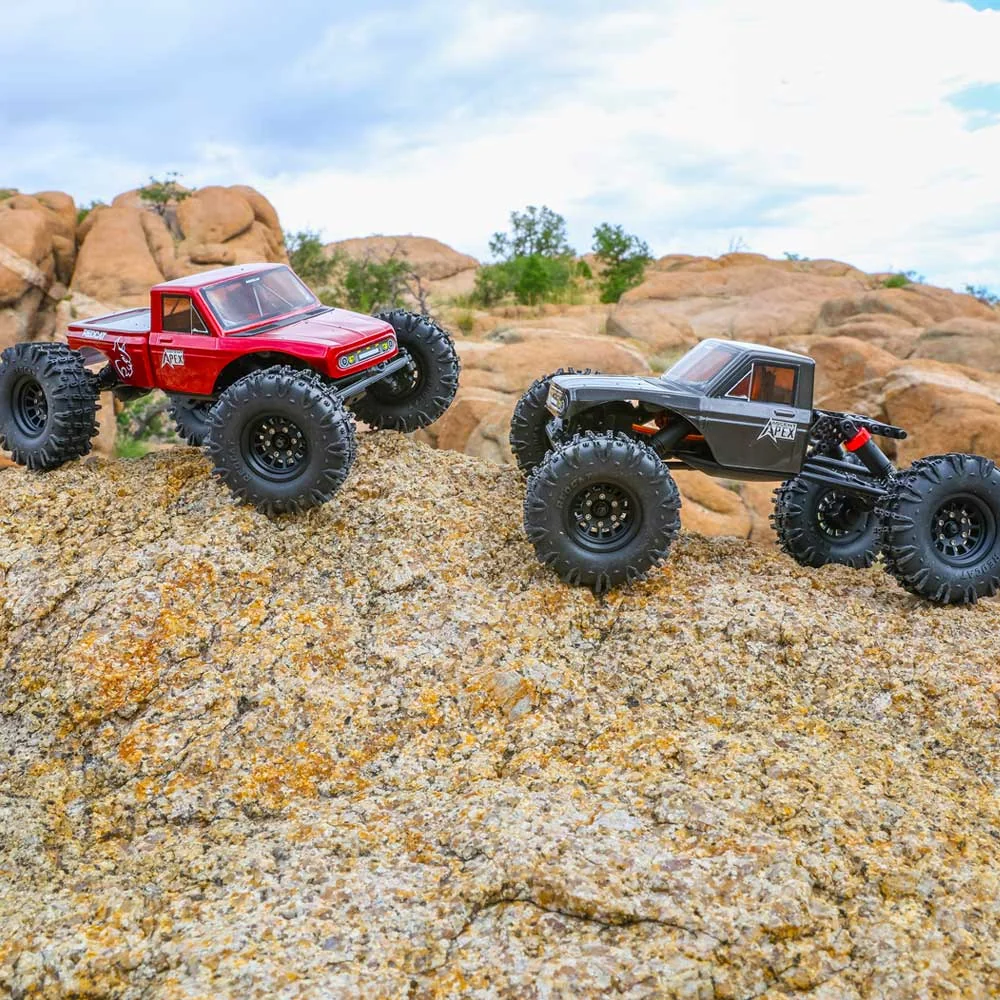
Unlike high-speed RC cars that need wide-open pavement or dirt tracks, an RC crawler turns small spaces into challenging obstacle courses. Choose your crawler based on where you plan to drive most often.
Living room & desk
1/24 & 1/30 micro crawlers
Drive anytime regardless of the weather. Couch cushions, books, and coffee tables become miniature mountain ranges. Micro crawlers (1/24 and 1/30 scale) are quiet, lightweight, and easy to pack in a bag.
Trade-off Small tires struggle in tall grass or deep outdoor ruts.
Compact enough to run on a coffee table, but with enough ground clearance and tire size to crawl across outdoor mulch, patio pavers, and small rock piles.
Trade-off Heavier outdoor boulders and fallen tree branches require careful line choice.
Built to walk alongside you on hiking trails. A heavier chassis and large tires climb over fallen branches, natural creek rocks, and steep dirt inclines with realistic scale suspension movement.
Trade-off Requires more storage space and outdoor room to drive.
A crawler looks like a miniature 4x4, but its internal mechanics are tuned completely differently from a high-speed RC car. Four features do the heavy lifting:
Ultra-low gearing (Crawl millimeter by millimeter)
Deep reduction gears trade top speed for massive wheel torque. This lets you feather the transmitter trigger to creep forward by millimeters without jerking forward or launching into an obstacle.
Locked 4-wheel drive (Never get stranded on three wheels)
In typical road cars, if one wheel spins in the air, all driving power is lost. On a crawler, both axles are locked so all four wheels turn together. Even if three wheels hang in mid-air, the one tire with grip pulls the whole truck forward.
Articulating multi-link suspension (Tires glued to the ground)
Multi-link solid axles can twist and tilt independently from the chassis. As the truck negotiates jagged terrain, the suspension flexes to keep all four tires pressed firmly against the surface for maximum traction.
Automatic hill hold / drag brake (No rolling backwards)
When you let go of the throttle trigger, the electronic speed controller (ESC) automatically holds the motor still. The truck stays parked on a 45-degree rock ledge without rolling back, giving you time to plan your next steering line.
Axle clearance, ledges, and crests
When a crawler gets hung up, it is usually because the axle housing snagged a rock or the center of the chassis bottomed out on a sharp crest. Here is how axle design and wheelbase change the drive.
Straight axle
Portal axle
Same tire size, different axle-housing height. The center housing is shown in blue. In the portal example, hub gears let the housing sit higher than the wheel centers. The diagram isolates one change, with tires held constant.
WheelbaseBelly contact
The middle can catch while the tires still have grip. Wheelbase is the distance between the axle centers. A shorter wheelbase can clear a sharper crest with the same belly clearance.
Straight axles vs. Portal axles
Straight axles run directly into the wheel hubs; they are durable, simple, and keep the truck’s center of gravity lower on steep side-hills. Portal axles place small gearboxes at each wheel hub, lifting the axle housing higher off the ground so jagged rocks pass underneath without snagging the center pumpkin.
Wheelbase and belly clearance
Wheelbase is the distance between front and rear axle centers. A shorter wheelbase clears sharp peaks (crests) without high-centering the belly. A longer wheelbase provides extra stability on steep, vertical climbs and prevents backward rollovers.
What “Ready to Run” (RTR) actually includes
Most crawlers are sold as RTR (Ready to Run), meaning the truck arrives fully assembled with its motor, speed controller, steering servo, and 2.4GHz radio receiver already wired and installed. Always check what else you need to get driving:
Vehicle battery & charger (Micro vs 1/10)
Micro crawlers (1/24 and 1/18) almost always include the rechargeable LiPo battery and a USB charging cord in the box. Full-sized 1/10 scale trail trucks often leave the battery and charger out so you can pick your preferred pack and fast charger. Check the listing’s “Needed to Complete” list.
Transmitter batteries
Handheld radios usually require 4 standard AA batteries that are not included in the box. Have a set of alkaline or rechargeable AAs ready before your truck arrives.
Replacement parts & hex tools
Crawlers are built to be maintained and upgraded. Most come with a small plastic wheel nut wrench. A standard set of metric hex drivers (1.5 mm, 2.0 mm, 2.5 mm) makes future maintenance, repairs, and wheel swaps easy.
How RC crawlers are sized: from scale ratios to real measurements
RC manufacturers label vehicle sizes using scale ratios, such as 1/10, 1/18, 1/24, and 1/30. In theory, this ratio tells you what fraction of a full-size vehicle the model represents. For example, a 1/10 scale crawler is designed to be roughly one-tenth the dimensions of a full-size 4x4, while a 1/24 scale truck is one-twenty-fourth the size.
Here is how those scale numbers typically translate when you are shopping:
1/10 Scale (The outdoor standard): Large, heavy trail rigs (typically 45 to 55 cm (18 to 22 in) long). Built with the mass and tire size to tackle real forest trails, mud, and outdoor boulders.
1/18 Scale (Mid-size trail & yard): Versatile compact rigs (around 20 to 28 cm (8 to 11 in) long). Big enough to crawl over outdoor mulch and roots, yet small enough to run on a coffee table.
1/24 Scale (The indoor favorite): Pocket-sized micro crawlers (around 18 to 20 cm (7 to 8 in) long). The most popular scale for couch-cushion courses, books, and desktop obstacles.
1/30 Scale (Ultra-micro): Palm-sized crawlers (around 13 to 16 cm (5 to 6 in) long). Designed specifically for tight indoor spaces and miniature desktop crawling.
The catch with scale ratios is that they depend on the vehicle being copied. A 1/10 scale model of a four-door, long-bed pickup truck is drastically longer and wider than a 1/10 scale model of a compact two-door rock crawler. On top of that, manufacturers often widen axles or enlarge tires to give a truck better climbing grip, which changes its physical footprint.
To make sizing straightforward and directly comparable across all brands, our catalog measures every crawler from bumper to bumper and groups them using everyday standard references: payment cards and A4 paper.
In the catalog, open Size and select Actual physical length to filter crawlers by everyday standard references:
Choose micro scale (up to 2 cards or 2 cards to A4) if you want to crawl inside the house anytime. Choose 1/10 scale (one to two A4 sheets) if you want an outdoor hiking companion for rocks and forest trails.
Check the Needed to Complete list
Verify if a drive battery and charger are included in the box. If they aren’t, budget $40 to $70 for a compatible battery pack and charger.
Pick your axle clearance
Go with straight axles for scale realism and lower center of gravity. Choose portal axles if your terrain has jagged rocks that could catch the axle center pumpkins.
Check spare parts availability
Crawlers will take roll-overs and scrapes. Pick established brands (such as Axial, Traxxas, or FMS) where replacement steering links, driveshafts, and tires are easy to find.
A few useful answers.
Do I need portal axles for my first crawler?
Straight axles are classic, reliable, mechanically simpler, and keep the truck’s center of gravity lower on side-hills. Portal axles lift the axle pumpkin to clear taller jagged rocks. For most beginners, straight axles are fantastic, but if your local terrain is full of sharp rocks that snag the axle center, portal axles are well worth it.
Is a brushless motor necessary for rock crawling?
Not at all. Brushed motors are affordable, smooth, and deliver plenty of gentle torque for a beginner. While specialized crawler brushless systems offer finer millimeter-level throttle control and longer battery life, a standard brushed Ready-to-Run (RTR) crawler climbs rocks right out of the box.
What is the difference between a rock crawler and a trail truck?
A rock crawler prioritizes extreme obstacle clearance, massive suspension flex, and light weight. A trail truck prioritizes realistic scale details (like licensed truck bodies, working headlights, and mirrors) with a slightly faster walking pace for outdoor hikes. Many modern rigs blend both.
Will a larger crawler climb better than a micro crawler?
A 1/10 scale crawler rolls over real outdoor obstacles, like thick grass, fallen tree branches, and creek boulders, that a micro crawler cannot cross. However, a micro crawler (1/24 or 1/18) turns your couch, desk, or garden bed into a world-class course without needing to leave the house. Choose based on where you have space to drive.