 Pace
PaceCould my savings cover my living costs?
The useful question is what your money could support. Spending, income, growth and rising prices all shape the answer. Pace brings them together so you can explore your own choices.
A balance is only part of the picture.
Money can support spending for a while without income. That is different from an estimate showing wealth could keep covering spending without a paycheck. Pace keeps those answers distinct.
Growth is an assumption you control. It is not a return Pace recommends or promises. Rising prices can also change how much your money needs to cover.
See what a change could mean.
The US example starts with $58,400 in wealth, $5,800 monthly income, $4,335 monthly spending and $720 in monthly debt payments. Pace shows about 17 years at the current pace.
Try spending less.
A $175 monthly spending reduction changes the displayed outlook to about 20 years.
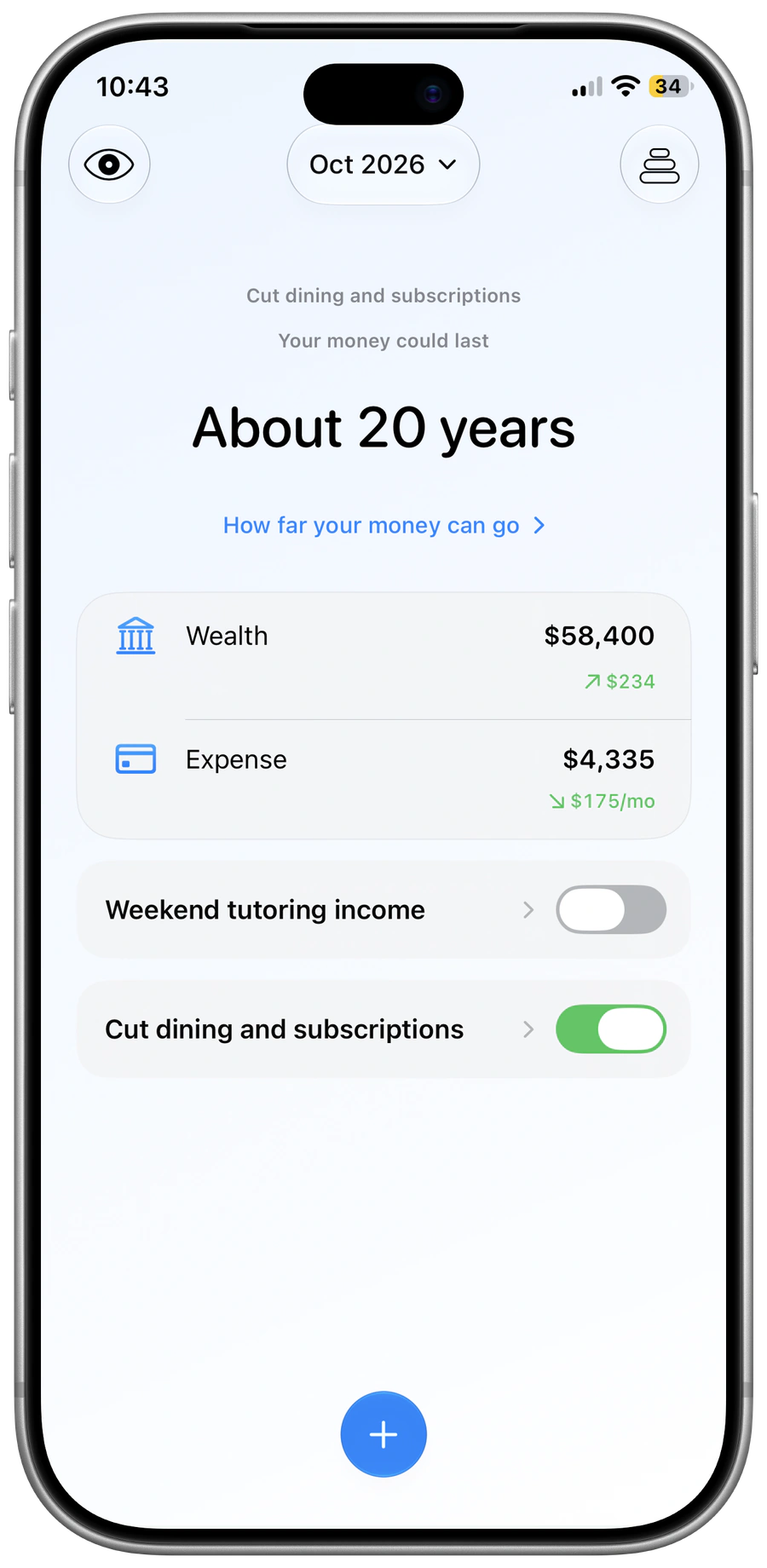
Try extra income.
The saved extra-income decision changes the displayed outlook to about 21 years.
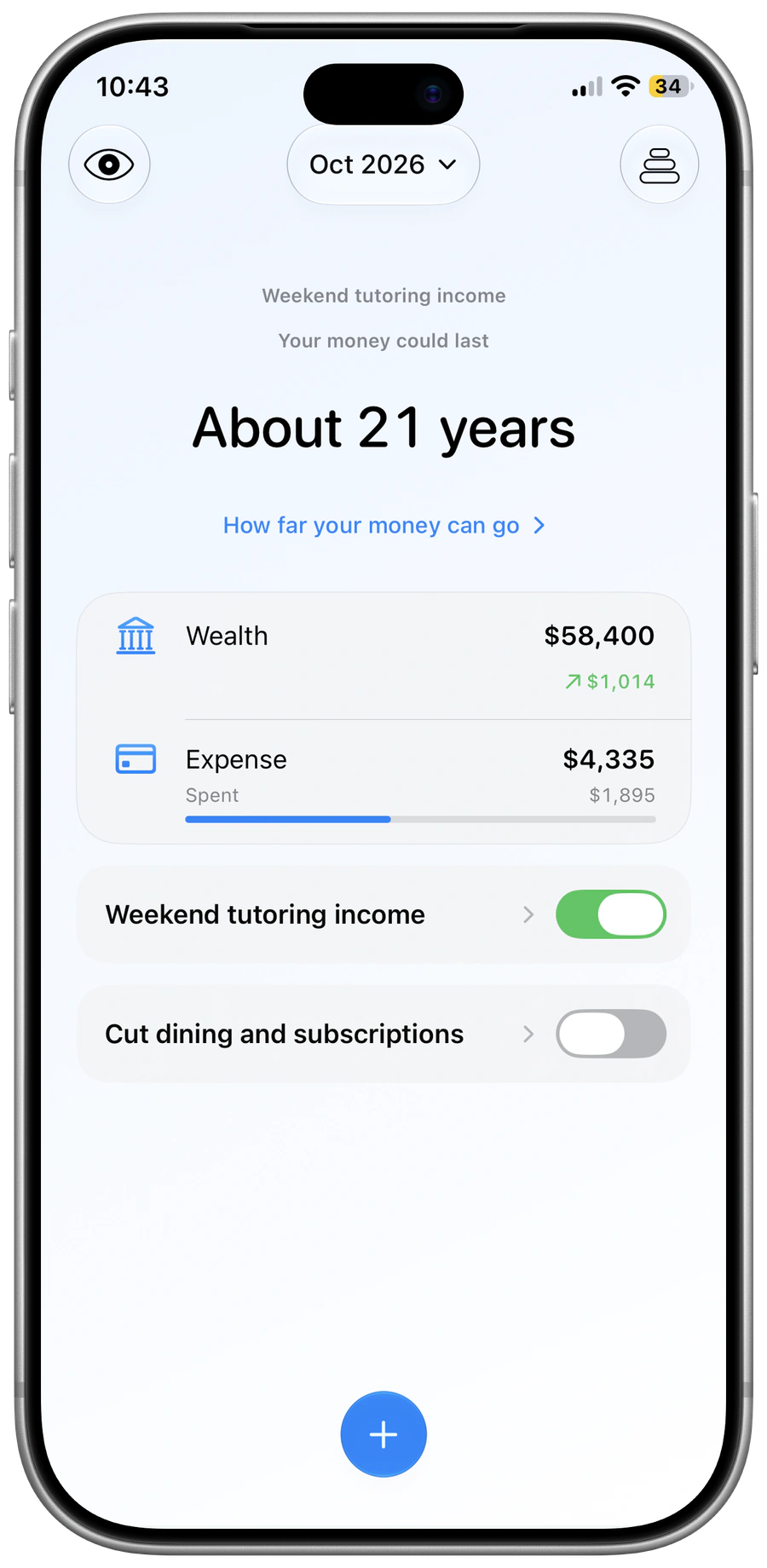
These examples combine wealth and continuing income. They do not mean the starting savings alone cover spending for those years, or show a date when work becomes optional.
What assumptions do these examples use?
3.85% yearly wealth growth, no future-savings growth, 2.85% inflation. These inputs are editable. Actual growth, spending and prices can change.
Try it with your numbers.
- Enter your wealth, spending, income and debt payments.
- Open How far your money can go from home. Check the growth and inflation assumptions.
- See your current answer, then try a decision. Pace Pro supports further exploration.
A few useful answers.
Is Covered for life a guarantee?
No. It describes an estimate under your chosen assumptions. Actual spending, prices and returns can change.
What if I do not know what growth to enter?
You can test different assumptions for existing wealth and future savings. Pace does not choose investments or promise a return. A lower estimate can show how much your outlook depends on growth.
Do I have to move my whole budget?
No. You can enter your current amounts and use Pace alongside another budgeting app. Recording or importing expenses is optional.
Try this with your numbers.
Start free with your current outlook and one saved decision. Pace Pro is a one-time purchase for more exploration. No bank login.